Brain tumours
A growth of abnormal cells inside the skull. Some are benign and slow, some are malignant, and some have spread from a cancer elsewhere. What it is, and where it sits, decides what can be done about it.
Greenslopes Private Hospital, Brisbane
Watkins Medical Centre, Spring Hill, or telehealth
A current GP or specialist referral is needed
At a glance
Gliomas, metastases, meningiomas, pituitary and other tumours.
Benign or malignant; primary or secondary.
MRI with contrast, sometimes CT or PET.
Tissue diagnosis from surgery or biopsy where needed.
Surgery, radiotherapy, chemotherapy, or monitoring.
Often a combination, planned with an oncology team.
Greenslopes Private Hospital (adults).
Queensland Children’s Hospital (children).
What a brain tumour is
A tumour is a group of cells growing where and how they should not. In the brain, the effect depends as much on position as on type.
Brain tumours are divided by where they come from. Primary tumours start in the brain or its coverings: gliomas arise from the brain’s supporting cells, meningiomas from the membranes around the brain, and pituitary adenomas from the gland at its base. Secondary tumours, or metastases, have spread to the brain from a cancer elsewhere in the body, most often lung, breast, bowel, kidney or skin.
Benign tumours grow slowly and do not spread, but can still cause serious problems by pressing on the brain or raising the pressure inside the skull. Malignant tumours grow faster and invade the tissue around them. Gliomas are graded from 1 to 4 on how their cells look under the microscope; the grade, together with molecular tests on the tissue, guides treatment and gives a realistic picture of what to expect.
Because the skull cannot expand, even a small tumour in the wrong place can cause symptoms, while a larger one in a quiet area may be found only by chance. This is why the position of a tumour matters as much as its type when the options are discussed.
Symptoms
Symptoms depend on where the tumour is and how quickly it is growing. Many are shared with far less serious conditions, which is why imaging is needed before anything is assumed.
- Headache that is new, persistent, worse in the morning or on lying flat, or accompanied by nausea
- Seizures, including a first seizure in an adult
- Weakness, numbness or clumsiness on one side of the body
- Difficulty with speech, understanding, reading or finding words
- Changes in vision, hearing or balance
- Changes in memory, concentration, personality or mood, often noticed by others first
A sudden severe headache, new weakness, confusion, drowsiness or a seizure needs an emergency department, not a website. Call 000.
How it is diagnosed
MRI with contrast is the main test; it shows the tumour’s size, position and relationship to important structures. CT is sometimes used first, and PET or specialised MRI sequences where they add information. Where a tissue diagnosis is needed to decide treatment, it comes from the operation itself or from a biopsy. When a metastasis is suspected, blood tests and a search for the primary cancer are part of the work-up.
The scan is on the screen, the options are set out on equal terms, and nothing is booked until you have had time to think.
Treatment options
The plan depends on the tumour’s type, grade and position, your age and general health, and what matters most to you. It is made with oncology, radiation oncology and, where relevant, endocrinology colleagues.
- SurgeryCraniotomy to remove as much of the tumour as can be taken safely, using the operating microscope, neuronavigation and, for malignant gliomas, a fluorescent dye that shows tumour tissue. Awake surgery where the tumour is near speech or movement areas.
- BiopsyA small sample taken through a keyhole opening when a diagnosis is needed before deciding on treatment, or when the tumour cannot be removed safely.
- RadiotherapyFocused radiation after surgery, or instead of it, planned by a radiation oncologist. Radiosurgery delivers a single high dose to a small target such as a metastasis.
- ChemotherapyDrug treatment for certain tumour types, coordinated by a medical oncologist and often combined with radiotherapy.
- MonitoringInterval MRI for small, slow-growing or symptom-free tumours where the risk of treatment outweighs the risk of leaving it alone.
Not every option applies to every person. Which ones apply to you, and in what order, is explained at the consultation and confirmed in writing before anything is booked.
Recovery and follow-up
Recovery depends on the operation, the tumour and the person. Follow-up is long term, and scans are part of it.
After a craniotomy most people spend several days in hospital, some of it in a high-dependency or intensive care unit, before going home or to rehabilitation. Tiredness is normal for weeks. Driving is not permitted for a period set by law and by the treating team, and return to work depends on the job. The pathology result usually takes about a week; the next steps are decided at a multidisciplinary meeting and then discussed with you and your family.
Follow-up MRI scans are scheduled according to the tumour type: more often at first, then at longer intervals if all is stable. Where radiotherapy or chemotherapy is part of the plan, the oncology team runs that part and keeps the rooms informed.
Living with the diagnosis
A brain tumour diagnosis affects the whole family. Questions from family are welcome at every appointment, and the rooms can point you to support organisations, allied health and rehabilitation services. Ask early; these are easier to arrange than to catch up on.
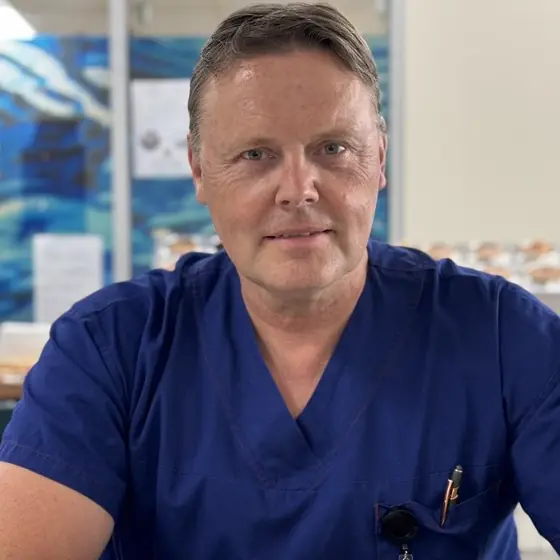
Dr Gert TollessonNeurosurgeon, Brisbane
Ready to talk it through?
A current referral is needed to book. If you do not have one yet, call the rooms on (07) 3870 3708 and they will explain what to ask your GP for.
Request a consultation
Send your details and the rooms will call you to arrange a time. Referrals are triaged as they arrive.
Monday to Friday, 8:30am to 4:30pm. No referral yet? The rooms will explain what to ask your GP for.
Before your appointment
What happens from referral to follow-up, and what it costs.