Trigeminal neuralgia and hemifacial spasm
Two conditions of the nerves that serve the face, most often caused by a small blood vessel pressing on a nerve where it leaves the brainstem. One causes severe pain; the other, twitching. Both start with medication. Surgery is for when medication is not enough.
Greenslopes Private Hospital, Brisbane
Watkins Medical Centre, Spring Hill, or telehealth
A current GP or specialist referral is needed
At a glance
Sudden electric-shock pain on one side of the face, in the cheek, jaw or forehead.
Triggered by touch, chewing, talking or cold air.
Involuntary twitching of one side of the face, usually starting around the eye.
Not painful; worse with stress and tiredness.
Usually a blood vessel compressing the nerve near the brainstem.
Occasionally multiple sclerosis or a tumour.
Medication first.
Microvascular decompression, injections or radiosurgery when medication is not enough.
What these conditions are
Where a nerve leaves the brainstem its insulation is thin, and a pulsing artery lying against it can make it misfire. Which nerve is involved decides whether the result is pain or spasm.
Trigeminal neuralgia affects the trigeminal nerve, which carries sensation from the face. The pain is brief, severe and electric, comes in bursts that can be set off by the lightest touch, and is one of the most severe pains known in medicine. Most cases are caused by a loop of artery or vein pressing on the nerve; a minority are caused by multiple sclerosis or, rarely, a tumour, which is why an MRI is always done. A related but rarer condition, glossopharyngeal neuralgia, causes the same kind of pain in the throat and ear.
Hemifacial spasm affects the facial nerve, which moves the muscles of the face. It causes involuntary twitching that usually begins around one eye and spreads over months or years to the cheek and mouth on the same side. It is not painful and not dangerous, but it is visible, distracting and tiring, and it does not settle on its own.
Both conditions are usually diagnosed from the story alone. The role of the scan is to look for the vessel and to rule out other causes.
Symptoms
The pattern is distinctive once it is recognised, but both conditions are often mistaken for something else at first.
- Trigeminal neuralgia: stabbing, electric-shock pain lasting seconds, on one side of the face, in bursts
- Trigeminal neuralgia: attacks triggered by touching the face, brushing teeth, chewing, talking, shaving or a breeze
- Trigeminal neuralgia: pain-free periods between attacks, which can last weeks or months and then return
- Hemifacial spasm: twitching of one eyelid that spreads to the cheek and corner of the mouth on the same side
- Hemifacial spasm: spasms that continue during sleep, and that worsen with fatigue, stress or reading
Facial pain is often first thought to be dental or sinus pain. Many people have seen a dentist, and some have had teeth removed, before the diagnosis is made.
How it is diagnosed
The diagnosis is made from the description of the pain or the twitching and from examination. An MRI with fine sequences through the brainstem looks for a blood vessel in contact with the nerve and excludes multiple sclerosis or a tumour. Where the story is not typical, a neurologist’s opinion is sought before anything else.
The scan is on the screen, the options are set out on equal terms, and nothing is booked until you have had time to think.
Treatment options
Medication is tried first for trigeminal neuralgia, and injections are the usual first treatment for hemifacial spasm. Surgery is considered when those are not working, are not tolerated, or when the person would prefer a more lasting solution.
- MedicationFor trigeminal neuralgia, carbamazepine or related medicines, prescribed and adjusted with your GP or a neurologist. They control the pain in most people at first, though doses often rise over time and side effects can limit them.
- Botulinum toxinFor hemifacial spasm, small injections into the affected muscles every three to four months, usually given by a neurologist. Effective for many; the effect wears off and the injections are repeated.
- Microvascular decompressionThrough a small opening behind the ear, under general anaesthetic, the vessel pressing on the nerve is lifted away and a small cushion is placed between them. The one treatment that addresses the cause, used for both conditions and for glossopharyngeal neuralgia. It is an operation near the brainstem, with risks that are discussed in detail beforehand.
- Percutaneous proceduresFor trigeminal neuralgia: a needle passed through the cheek to the nerve root under X-ray guidance, using glycerol, a balloon or radiofrequency heat. Quicker to recover from, usually causing some facial numbness, and the pain is more likely to return.
- RadiosurgeryFocused radiation to the trigeminal nerve root, planned with a radiation oncologist, with no incision. Pain relief develops over weeks to months and some numbness is expected.
Not every option applies to every person. Which ones apply to you, and in what order, is explained at the consultation and confirmed in writing before anything is booked.
Recovery and follow-up
After microvascular decompression, recovery is measured in weeks. Medication is reduced gradually, not stopped on the day.
A hospital stay of two to four days is usual after microvascular decompression, followed by headache, tiredness and some discomfort behind the ear for a few weeks. Hearing on the operated side is checked afterwards. Most people are back to their usual activities within four to six weeks.
For trigeminal neuralgia, pain relief is often immediate but can take days or weeks to settle fully; medication is tapered with the prescriber rather than stopped abruptly. For hemifacial spasm, the twitching can stop at once or fade over weeks to months. Follow-up at the rooms continues until the result is clear and stable.
If pain or spasm returns
Symptoms can recur after any of these treatments, sometimes years later. A return does not mean nothing can be done; the options are reviewed again, and a different one may suit better the second time.
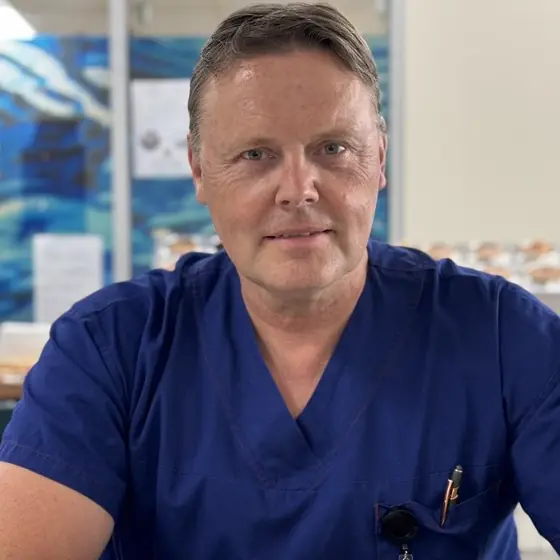
Dr Gert TollessonNeurosurgeon, Brisbane
Ready to talk it through?
A current referral is needed to book. If you do not have one yet, call the rooms on (07) 3870 3708 and they will explain what to ask your GP for.
Request a consultation
Send your details and the rooms will call you to arrange a time. Referrals are triaged as they arrive.
Monday to Friday, 8:30am to 4:30pm. No referral yet? The rooms will explain what to ask your GP for.
Before your appointment
What happens from referral to follow-up, and what it costs.