Craniotomy for tumours
The standard operation for most brain tumours. A section of skull is temporarily removed under general anaesthetic, the tumour is treated under the operating microscope, and the bone is replaced and fixed in place at the end.
Greenslopes Private Hospital, Brisbane
Watkins Medical Centre, Spring Hill, or telehealth
A current GP or specialist referral is needed
At a glance
General, or awake for part of the operation when the tumour is near speech or movement areas.
Usually three to six hours, depending on the tumour.
Typically three to seven days, with the first night in a high-dependency or intensive care bed.
Greenslopes Private Hospital; Queensland Children’s Hospital for children.
What a craniotomy is
Craniotomy means opening the skull. What is done through the opening depends on the tumour: complete removal where that is safe, partial removal where it is not, or a biopsy alone.
After the scalp is opened, a small plate of bone is lifted out and the membrane beneath it is opened to reach the brain. The tumour is then removed under the operating microscope, with the instruments tracked on your own MRI by a neuronavigation system so that the approach stays on course and the edges of the tumour can be checked against the scan.
For malignant gliomas, a fluorescent dye (5-ALA) taken by mouth before surgery makes tumour tissue glow under a special light on the microscope, which helps to separate it from normal brain. For tumours near the areas that control speech or movement, part of the operation can be done with you awake, so those functions can be tested while the tumour is removed and the operation adjusted if they change.
At the end, the bone plate is fixed back in place with small titanium plates that stay permanently and do not set off airport scanners. The scalp is closed with sutures or staples, which are removed at the rooms around ten days later.
How much of the tumour is removed
The aim is to remove as much as can be removed safely. For some tumours that means all of it; for others, where the tumour runs into brain that cannot be sacrificed, a deliberate decision is made to leave part behind and treat it in other ways. That balance is discussed with you before the operation, and the scan after surgery shows what has been achieved.
Before and during the procedure
Most of the preparation happens at the rooms and in the pre-admission clinic in the two weeks before surgery.
- A planning MRI with navigation markers, usually a day or two before surgery, and any other imaging or tests the anaesthetist requests
- Blood-thinning medication, some supplements and some diabetes medications are stopped or adjusted on the anaesthetist’s instructions; do not stop anything without being told to
- Steroids are often started a few days before surgery to reduce swelling around the tumour, and continued for a period afterwards
- Fasting from midnight before a morning operation; admission is usually on the day of surgery
- A small area of hair is clipped along the incision line; the head is not shaved
- Your next of kin is telephoned by Dr Tollesson after the operation, and can visit once you are settled on the ward
If a biopsy is all that is needed
Where the plan is to obtain tissue rather than remove the tumour, a needle biopsy through a small opening the width of a coin, guided by neuronavigation, may be used instead. It is a shorter procedure with a shorter stay, and the tissue result guides what happens next.
Planning is done on your own imaging, and the operation is only booked once you have had time to think.
Recovery and risks
Most people are up and walking the day after surgery and home within the week. Feeling fully yourself again takes longer.
The first night is spent in a high-dependency or intensive care bed for close observation, and a CT or MRI is done within the first day or two to check the result. Headache, swelling around the eye on the operated side and tiredness are usual in the first week and settle. Most people are home between the third and seventh day, with instructions for the wound, medication and who to call.
Fatigue is the main feature of the following month. A gradual return to activity is expected; driving is not permitted for a period set by the type of operation and whether there has been a seizure, and this is confirmed in writing. The pathology result is discussed with you and your family at the rooms, together with any further treatment. Where radiotherapy or chemotherapy is recommended, it is coordinated with the oncology team and usually begins a few weeks after surgery, once the wound has healed.
Risks that are discussed with you
- Bleeding into or around the operation site, which may need a further operation
- Infection of the wound, the bone flap or the fluid around the brain
- New or worsened weakness, numbness, speech, vision or memory difficulty, temporary or permanent, depending on the position of the tumour
- Seizures, during recovery or later; anti-seizure medication is used where the risk warrants it
- Leak of cerebrospinal fluid through the wound
- Blood clots in the legs or lungs, and the general risks of a long general anaesthetic
- The tumour not being fully removed, or growing back over time
Every operation carries risks, and the risks of brain surgery are discussed with you in detail, in person, before you decide. The list here is general and is not a substitute for that conversation.
Alternatives
A craniotomy is not the only way to treat a brain tumour, and for some tumours it is not the right one.
- ObservationInterval MRI for small, slow-growing or symptom-free tumours, with surgery held in reserve if the scan or the symptoms change.
- Biopsy aloneA tissue diagnosis through a small opening where removal is not safe or not needed before other treatment.
- RadiosurgeryFocused radiation in one or a few sessions for small tumours and some metastases, planned with a radiation oncologist and given without an incision.
- Radiotherapy and chemotherapyFor some tumours, particularly high-grade gliomas and multiple metastases, treatment with the oncology team may be used instead of, or as well as, surgery.
Which of these applies to you depends on your condition and your circumstances. The alternatives are set out at the consultation on equal terms with surgery, and nothing is booked until you have had time to think.
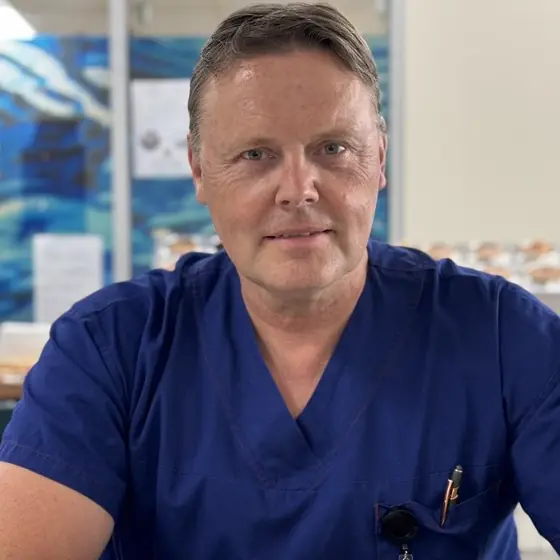
Dr Gert TollessonNeurosurgeon, Brisbane
Ready to talk it through?
A current referral is needed to book. If you do not have one yet, call the rooms on (07) 3870 3708 and they will explain what to ask your GP for.
Request a consultation
Send your details and the rooms will call you to arrange a time. Referrals are triaged as they arrive.
Monday to Friday, 8:30am to 4:30pm. No referral yet? The rooms will explain what to ask your GP for.
Before your appointment
What happens from referral to follow-up, and what it costs.