Endoscopic and pituitary surgery
Pituitary tumours, and some tumours at the base of the skull, are reached through the nostril with an endoscope, so there is no incision on the outside. Tumours deep in the fluid chambers of the brain can be reached the same way through a keyhole opening in the skull.
Greenslopes Private Hospital, Brisbane
Watkins Medical Centre, Spring Hill, or telehealth
A current GP or specialist referral is needed
At a glance
Endoscopic endonasal: through the nose, with no external incision.
Neuroendoscopy through a keyhole for deep tumours.
General.
Usually two to four hours.
Typically two to four days.
Endocrinology and ENT colleagues before and after surgery.
What the operation involves
The pituitary gland sits in a small bony hollow directly behind the back of the nose. That is the shortest and most direct route to it.
Under general anaesthetic, a thin telescope with a camera is passed through one nostril to the back of the nasal cavity. A small opening is made in the thin bone at the back of the nose and into the floor of the hollow that holds the gland. The tumour is removed piece by piece with fine instruments alongside the endoscope, with the view magnified on a screen. An ENT surgeon often opens the approach and helps close it, and Dr Tollesson removes the tumour.
At the end, the opening is sealed, sometimes with a small piece of tissue taken from the abdomen or thigh, and the nose is packed for a day or two. There are no stitches to see and no visible scar. Most people are surprised by how little discomfort there is compared with what they expected.
Some other tumours at the base of the skull, such as craniopharyngiomas and some meningiomas and chordomas, can be reached the same way, which avoids moving the brain aside. Tumours inside the fluid chambers of the brain can be treated with an endoscope passed through a small opening in the skull, in the same way that an endoscopic third ventriculostomy is done.
Hormones before and after
Before surgery, an endocrinologist checks how the gland is working and whether the tumour is producing hormone. Some tumours, particularly prolactinomas, are treated with tablets rather than surgery. After surgery, hormone levels are watched closely for a few days and then at intervals, because the gland may need support, temporarily or permanently.
Before and during the procedure
The preparation is shared between the rooms, the endocrinologist and the anaesthetist.
- Blood tests for pituitary hormones, and eye tests where the tumour is near the optic nerves, before the operation
- A planning MRI and CT of the sinuses for navigation
- Blood-thinning medication is stopped on the anaesthetist’s instructions; steroid cover is arranged where the gland is not producing enough cortisol
- Fasting from midnight; admission on the day of surgery
- Nose packing for one to two days afterwards; breathing through the mouth for that period
- Your next of kin is telephoned after the operation
Planning is done on your own imaging, and the operation is only booked once you have had time to think.
Recovery and risks
Recovery is faster than after a craniotomy. The nose, and the hormones, take a few weeks to settle.
Most people are home on the second to fourth day. A blocked nose, some blood-stained discharge and a dull headache are usual for the first week or two; nasal rinses help. No nose-blowing, straining or heavy lifting for about four weeks, to protect the seal at the back of the nose. Fluid intake and urine output are watched in hospital and for a period afterwards, because the gland controls water balance and can be temporarily upset.
An MRI at about three months shows what has been removed; scans before that are hard to interpret because of swelling. The endocrinologist reviews hormone levels at intervals and adjusts any replacement. Where tumour remains, or where hormone levels do not settle, the options of watching, medication or radiosurgery are discussed. Some tumours are followed with scans for many years.
Risks that are discussed with you
- Leak of cerebrospinal fluid through the nose, which may need a further procedure to seal
- Nasal bleeding, sinus infection, a change in sense of smell, or crusting in the nose
- Meningitis, uncommon but serious
- Low pituitary hormone levels needing replacement, temporarily or for life
- Disturbed water balance, usually temporary, occasionally lasting
- Injury to the optic nerves or the carotid arteries, which run beside the gland; rare, and the reason for careful navigation
- Tumour that cannot be fully removed, or that regrows
Every operation carries risks, and the risks of brain surgery are discussed with you in detail, in person, before you decide. The list here is general and is not a substitute for that conversation.
Alternatives
Not every pituitary tumour needs surgery, and for some it is not the first choice.
- MedicationProlactinomas usually respond to tablets that shrink the tumour and normalise the hormone, with surgery reserved for those that do not.
- ObservationSmall tumours that are not producing hormone and not pressing on the optic nerves are often followed with scans and blood tests.
- RadiosurgeryFocused radiation for tumour that remains after surgery or cannot be reached, planned with a radiation oncologist; the effect on hormone levels develops slowly.
- CraniotomyOccasionally, for large tumours that extend well above the gland, an operation through the skull is needed instead of or as well as the endonasal approach.
Which of these applies to you depends on your condition and your circumstances. The alternatives are set out at the consultation on equal terms with surgery, and nothing is booked until you have had time to think.
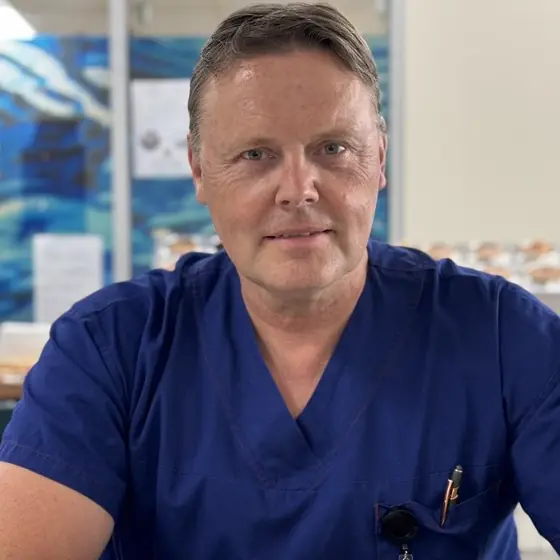
Dr Gert TollessonNeurosurgeon, Brisbane
Ready to talk it through?
A current referral is needed to book. If you do not have one yet, call the rooms on (07) 3870 3708 and they will explain what to ask your GP for.
Request a consultation
Send your details and the rooms will call you to arrange a time. Referrals are triaged as they arrive.
Monday to Friday, 8:30am to 4:30pm. No referral yet? The rooms will explain what to ask your GP for.
Before your appointment
What happens from referral to follow-up, and what it costs.