Microvascular decompression
For trigeminal neuralgia or hemifacial spasm that medication no longer controls. Through a small opening behind the ear, the blood vessel pressing on the nerve is lifted away and a small cushion is placed between them to relieve the pressure on the nerve.
Greenslopes Private Hospital, Brisbane
Watkins Medical Centre, Spring Hill, or telehealth
A current GP or specialist referral is needed
At a glance
Trigeminal neuralgia, hemifacial spasm, glossopharyngeal neuralgia.
General.
Usually two to three hours.
Typically two to four days.
Greenslopes Private Hospital.
What the operation involves
It is the one treatment for these conditions that addresses the cause rather than the symptom. It is also an operation near the brainstem, and is offered with that in mind.
Under general anaesthetic, an incision is made behind the ear on the affected side and a small opening, the size of a large coin, is made in the skull. Under the operating microscope, the cerebellum is gently eased aside to expose the nerve where it leaves the brainstem. The artery or vein lying against it is identified, separated from the nerve, and held away with a small pad of Teflon felt that stays permanently. The bone opening is covered with a small titanium plate and the wound closed.
For trigeminal neuralgia the trigeminal nerve is decompressed; for hemifacial spasm, the facial nerve, with the facial muscles monitored electrically during the operation so that the surgeon can see when the pressure has been relieved. For glossopharyngeal neuralgia the ninth and tenth nerves are treated the same way. Occasionally no vessel is found in contact with the nerve; what is done then is discussed with you beforehand.
The operation is offered when medication has stopped working, is causing side effects that are hard to live with, or when a person would rather have a treatment that may last than one that needs repeating. It is not the first step for either condition.
Before and during the procedure
An MRI with fine sequences through the brainstem is done before the decision, and the medication plan is agreed before the operation.
- MRI to look for the vessel and exclude other causes; a neurologist’s review where the diagnosis is not typical
- Medication is continued up to the operation and reduced gradually afterwards, on a plan agreed with the prescriber; it is not stopped on the day
- Blood-thinning medication stopped on the anaesthetist’s instructions
- A hearing test before the operation, because the hearing nerve runs beside the facial nerve
- Fasting from midnight; admission on the day of surgery; a small area of hair clipped behind the ear
- Your next of kin is telephoned after the operation
Planning is done on your own imaging, and the operation is only booked once you have had time to think.
Recovery and risks
Recovery is measured in weeks. Whether the operation has worked is usually clear early, though it can take longer to settle.
Headache, nausea and unsteadiness are common in the first few days, from the disturbance to the cerebellum and to the fluid around the brain, and improve steadily. Most people are home on the second to fourth day and back to usual activities within four to six weeks, avoiding heavy lifting and straining in the meantime. Hearing on the operated side is checked afterwards.
For trigeminal neuralgia, the pain is often gone on waking, though in some it fades over days or weeks; medication is then tapered with the prescriber. For hemifacial spasm, the twitching may stop at once or fade over weeks to months. Symptoms can return after any treatment for these conditions, sometimes years later. If they do, the options are reviewed again, and a repeat operation or a different procedure may be suitable.
Risks that are discussed with you
- Hearing loss on the operated side, partial or complete; the most specific risk of this operation
- Facial numbness (after trigeminal decompression) or facial weakness (after facial nerve decompression), usually temporary, occasionally lasting
- Leak of cerebrospinal fluid through the wound or the ear, which may need a further procedure
- Infection, including meningitis
- Bleeding or stroke in the cerebellum or brainstem; rare, and the most serious
- Persistent headache, unsteadiness or double vision for a period
- The pain or spasm not improving, or returning later
Every operation carries risks, and the risks of brain surgery are discussed with you in detail, in person, before you decide. The list here is general and is not a substitute for that conversation.
Alternatives
Medication comes first, and for hemifacial spasm injections are usually tried before surgery is considered.
- MedicationCarbamazepine and related medicines control trigeminal neuralgia in most people at first, prescribed and adjusted with your GP or neurologist.
- Botulinum toxinFor hemifacial spasm, injections into the affected muscles every three to four months, usually given by a neurologist.
- Percutaneous proceduresFor trigeminal neuralgia: glycerol, balloon compression or radiofrequency treatment of the nerve root through a needle in the cheek, under X-ray guidance. A shorter recovery, with some numbness expected and a higher chance of the pain returning.
- RadiosurgeryFocused radiation to the trigeminal nerve root, planned with a radiation oncologist, with no incision. Relief develops over weeks to months.
Which of these applies to you depends on your condition and your circumstances. The alternatives are set out at the consultation on equal terms with surgery, and nothing is booked until you have had time to think.
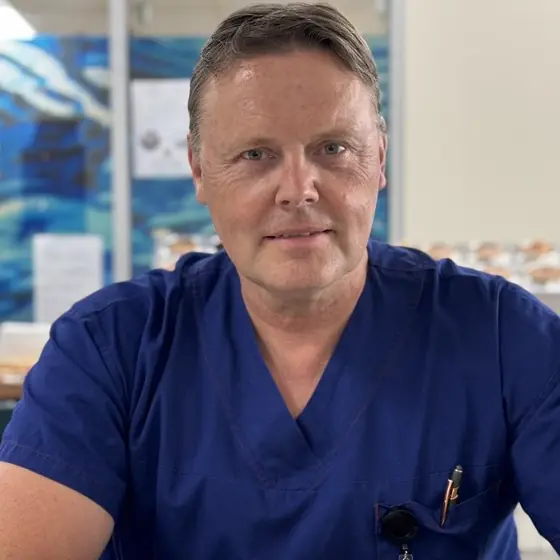
Dr Gert TollessonNeurosurgeon, Brisbane
Ready to talk it through?
A current referral is needed to book. If you do not have one yet, call the rooms on (07) 3870 3708 and they will explain what to ask your GP for.
Request a consultation
Send your details and the rooms will call you to arrange a time. Referrals are triaged as they arrive.
Monday to Friday, 8:30am to 4:30pm. No referral yet? The rooms will explain what to ask your GP for.
Before your appointment
What happens from referral to follow-up, and what it costs.